PSU Welcomes Digital Economy Minister to Discuss Disaster Preparedness and Shelter Management in Songkhla
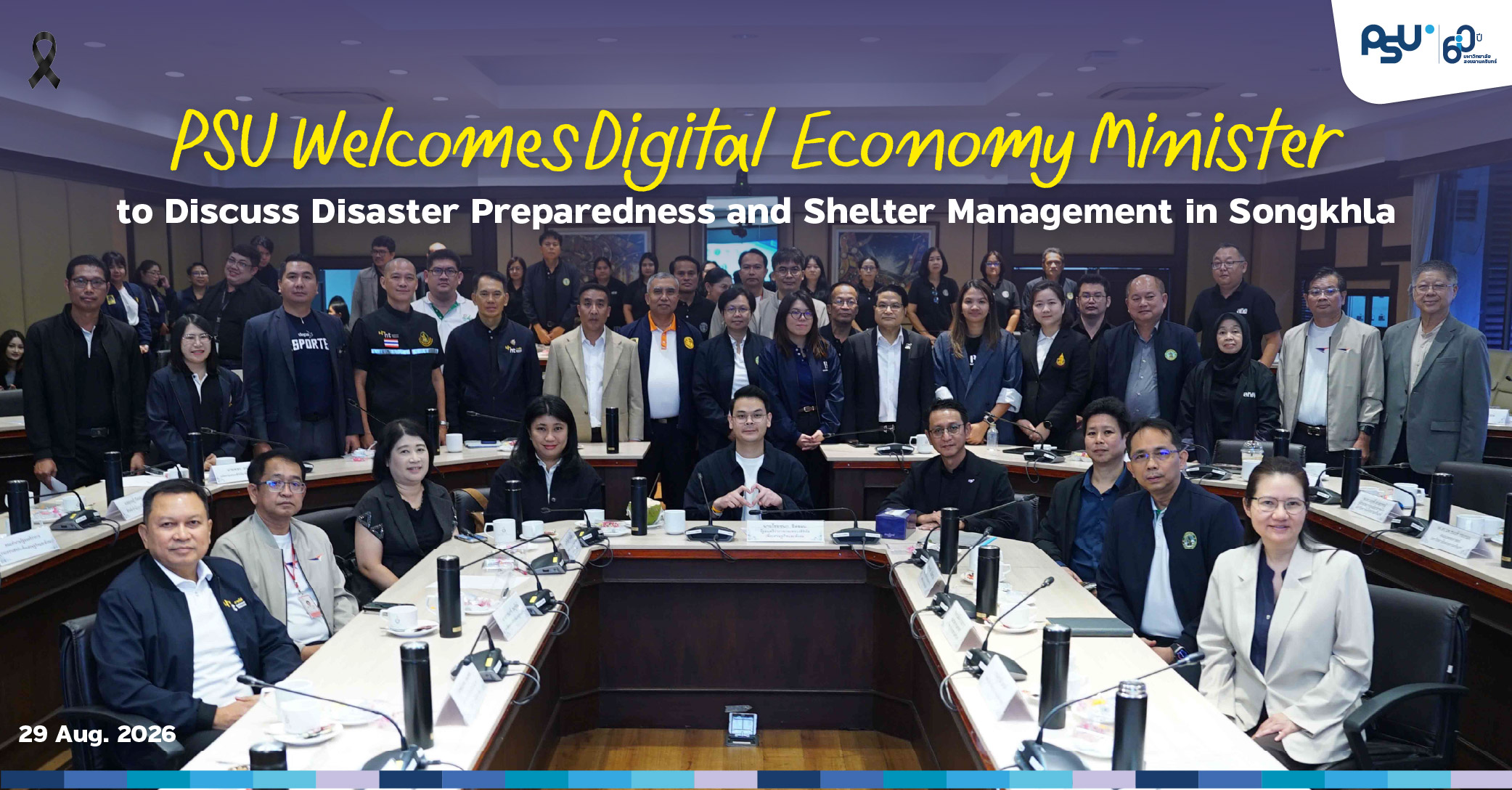
Prince of Songkla University (PSU), led by Assoc. Prof. Dr. Tanit Chalermyanont, Vice President for Planning and Finance, welcomed Mr. Chaichanok Chidchob, Minister of Digital Economy and Society (DE), who chaired a meeting on water management and urban infrastructure improvement to enhance drainage efficiency. The meeting was attended by Ms. Chomparee Chompurat, Deputy Permanent Secretary of the Ministry of Digital Economy and Society; Prof. Dr. Tiranee Achalakul, President of the Big Data Institute (BDI); Mr. Nattawut Dandee, Deputy Director-General of the Thai Meteorological Department, as well as representatives from the private sector, civil society, and relevant organizations. The meeting was held at Meeting Room 210, Office of the President, Prince of Songkla University, Hat Yai Campus, on August 29, 2026.

During the meeting, Mr. Chaichanok emphasized the importance of integrating data and strengthening cooperation among relevant sectors to improve disaster monitoring and early warning, evacuation procedures, and shelter management. He also highlighted the need to improve digital data connectivity across government agencies, alongside support from the private sector and cooperation from the public, to strengthen overall disaster management.
Communication infrastructure was another key issue discussed at the meeting. The Minister said relevant agencies had been instructed to accelerate improvements to communication and electricity systems to strengthen their reliability during emergencies. The Minister also expressed appreciation for PSU’s efforts to draw lessons from the flooding that affected Hat Yai District, Songkhla Province, in the previous year and to translate those lessons into the “Hat Yai Model Plus” initiative.
According to the Minister, the initiative seeks to strengthen research and technology for urban flood management in Hat Yai by integrating data, technology, and cooperation among multiple sectors. Its areas of focus include improving early-warning systems, crisis management, public assistance, and data-informed policy decision-making, while strengthening the city’s long-term disaster resilience and exploring approaches that could potentially be adapted for other areas of Thailand.

Assoc. Prof. Dr. Tanit Chalermyanont said PSU was honored to welcome the Minister of Digital Economy and Society and expressed appreciation for the government’s attention to the challenges faced by communities affected by flooding. He explained that lessons from the severe flooding in the previous year highlighted areas where early-warning and disaster-management systems could be further strengthened. With academic staff and specialists from a wide range of disciplines, PSU aims to contribute its expertise through the Hat Yai Model Plus initiative. The project draws on lessons from actual events and collaborative reviews conducted with the National Research Council of Thailand (NRCT) and other relevant sectors, with particular emphasis on preparedness and emergency response.
One of the key priorities is the development of a faster and more accurate early-warning system, giving residents sufficient time to prepare, move their belongings to safer locations, and evacuate from areas at risk. Another priority is strengthening the Emergency Operations Center (EOC) by integrating information technology into its supporting systems. This is intended to improve coordination, resource allocation, and assistance to communities during emergencies.

Hat Yai Model Plus also places importance on strengthening community preparedness, including knowledge of emergency procedures and evacuation. According to PSU, Hat Yai had not experienced flooding on such a large scale for an extended period. As a result, some residents, particularly younger generations, may have had limited experience in preparing for and responding to a major disaster. Building public knowledge and preparedness is therefore regarded as an important part of strengthening the city’s overall capacity to respond to future emergencies. From Emergency Shelter to “Smart Shelter” Another important lesson came from PSU’s experience in operating an emergency shelter during the previous flood.
The University had initially prepared its sports complex to accommodate approximately 500 evacuees. However, as the situation became more severe than anticipated, approximately 15,000 people sought shelter at the University. While PSU was able to manage the situation and provide assistance, the experience led to the development of the “Smart Shelter” concept, which aims to strengthen the management of large-scale emergency shelters and improve their preparedness, coordination, and operational efficiency. Using AI and Digital Data for Disaster Management


A further component of Hat Yai Model Plus is the planned application of artificial intelligence (AI) and digital information systems to disaster management. PSU plans to develop information technology systems capable of tracking key operational information, including who has requested assistance, who has already received support, which locations are still awaiting assistance, where available resources have been deployed, and what resources remain available.
The information would be integrated into a centralized dashboard, providing incident commanders, provincial authorities, and national-level administrators with an overview of the situation. The system is intended to support timely, data-informed decision-making and enable resources and assistance to be directed more efficiently to areas where they are most needed. Through Hat Yai Model Plus, PSU is bringing together lessons from previous flooding, multidisciplinary research, digital technology, and cross-sector collaboration to strengthen preparedness and disaster-management systems for Hat Yai and surrounding communities.