Behind the Success PSU Phuket’s Hospitality and Leisure Management Program Earns a Place Among the World’s Top 100
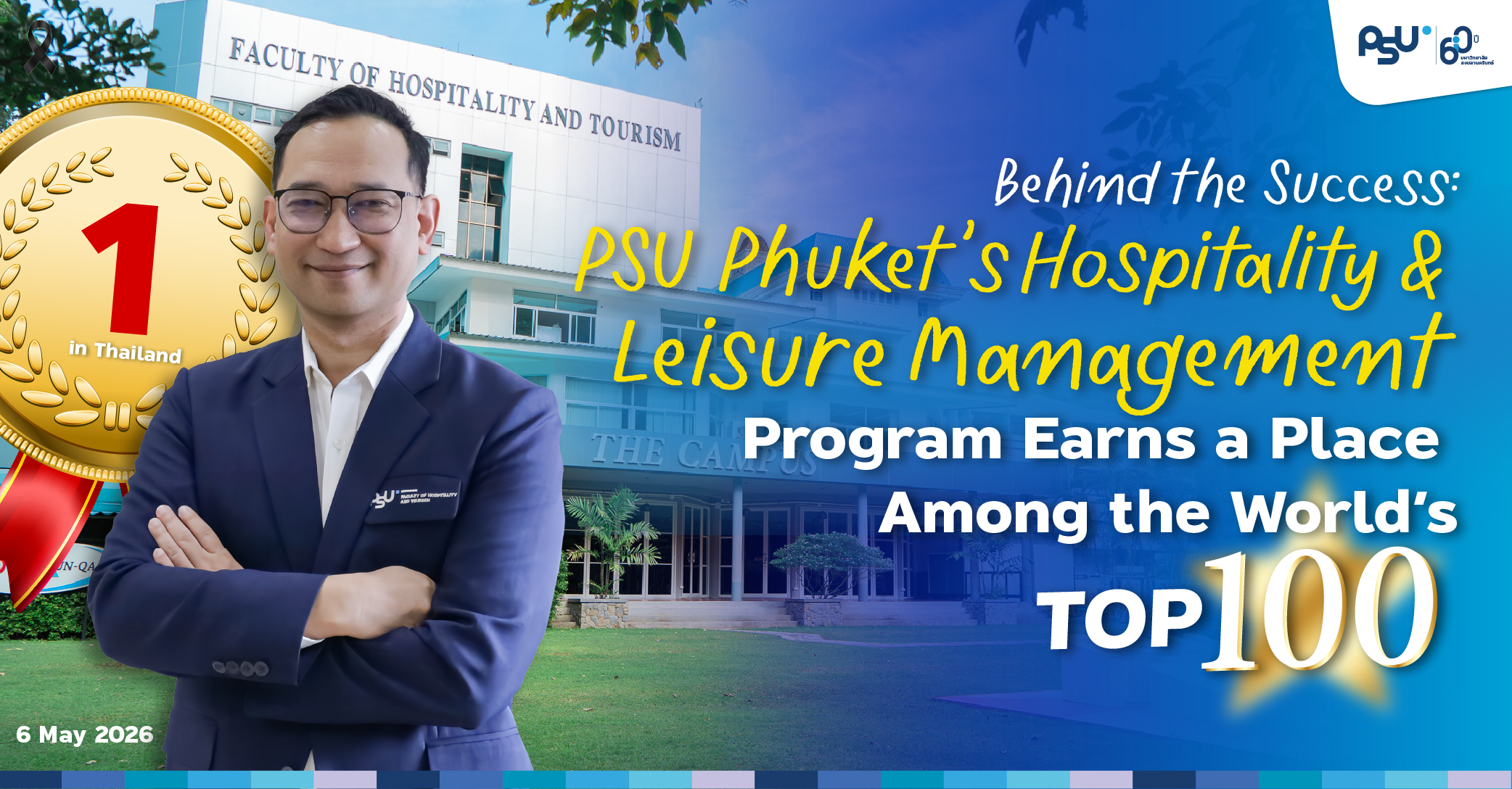
PSU Connext takes a closer look behind the success of the Faculty of Hospitality and Tourism, Prince of Songkla University, Phuket Campus. This achievement has become both a source of pride and a responsibility, as the faculty has gained international recognition and advanced into the world’s Top 100 in 2026. In this feature, we speak with Assoc. Prof. Dr. Pornpisanu Promsivapallop, Dean of the Faculty of Hospitality and Tourism, Prince of Songkla University, Phuket Campus.
“this success did not come from the effort of any single person. Rather, it is the result of collaboration from all sectors, including the university, administrators, lecturers, staff, students, alumni, industry partners, and cooperation networks both in Thailand and overseas. He said the achievement is both a matter of pride and responsibility. Once international recognition has been achieved, the most important task is to maintain that standard and continue improving without pause.”
What does this success mean for the faculty and for the direction of Thai tourism?
This is a great source of pride for the Faculty of Hospitality and Tourism, Prince of Songkla University, Phuket Campus. It clearly reflects that the faculty’s continuous quality development in every dimension has been recognized at the international level. For the faculty, this achievement means recognition in academic quality from both Thai and international academic circles. It also reflects the quality of its graduates as recognized by the hospitality and tourism industry. This is especially meaningful because the faculty has always given equal importance to academic excellence and graduates’ readiness for real-world work. He added that the achievement also reflects the faculty’s ability to develop internationalization and international quality across all areas, including curriculum, teaching and learning, research, faculty development, cooperation networks, and academic roles on the global stage.
At the national level, this success shows that Thailand does not only have strengths in tourism resources and service excellence. The country also has the potential to develop educational institutions that can produce high-quality professionals, create knowledge, and help raise the standards of Thailand’s tourism and hospitality industries to gain global recognition. It also points to an important future direction for Thai tourism, where competitiveness must increasingly be driven by quality, international standards, innovation, sustainability, and highly capable human resources.
What are the key factors that helped the faculty raise its quality to international recognition?
The key factors came from systematic and continuous development in several areas. The first factor is a clear vision to move toward international standards in academics, professional practice, and industry engagement. The faculty has placed serious emphasis on developing lecturers, research, and academic work. It has also applied knowledge from research, international experience, and industry collaboration to make teaching and learning more modern and closely connected to the real world. The faculty has also implemented high-impact international projects and received international curriculum accreditations such as TEDQUAL and AUN-QA. At the same time, it has encouraged staff to improve their academic capacity and teaching standards at the international level, including through UKPSF.
Another important factor is the creation of a genuinely international environment through diverse students and lecturers, exchange programs, Double Degree Programs, invitations to world-class Visiting Professors, and the positioning of the faculty as a Hub of Global Experts in Hospitality and Tourism. At the same time, the faculty has strong cooperation with businesses and the tourism and hospitality industries. This ensures that the curriculum and teaching are aligned with actual labor market needs and that graduates are well-prepared in both academic knowledge and practical skills.
What makes the faculty distinctive and competitive internationally, and how is this connected to Phuket?
The faculty’s key strength is the integration of international education with practical learning from the real industry under the concept of “A World Class Education in a World Class Destination.” Phuket, as a world-class tourism destination, serves as a living laboratory for students. They do not learn only in classrooms or laboratories. They learn directly from the real context of the hospitality and tourism industries, including hotels, resorts, food and beverage businesses, events, aviation businesses, and tourism organizations. This gives students direct experience with real operators, real tourists, and real situations.
The faculty also works closely with industry partners while building an international atmosphere through students and lecturers from various countries, exchange programs, and Double Degree Programs with leading universities around the world. In addition, the faculty has positioned itself as a Hub of Global Experts in Hospitality and Tourism by inviting world-class Visiting Professors to teach, conduct research, and publish academic work with the faculty’s lecturers.
What impact is expected for students, entrepreneurs, the tourism and hospitality sector, and confidence in the faculty’s graduates?
This success will have a positive impact on students, graduates, and the industry. For students, it will create pride, inspiration, and confidence that they are studying in a faculty with quality and global recognition. The faculty does not focus only on classroom teaching. It places strong importance on holistic student development through support systems, extracurricular activities, industry-based learning, fieldwork, projects, practical training, and collaboration with international students. These experiences help strengthen professional skills, language ability, communication skills, and multicultural understanding.
The faculty also aims to develop students who can think critically, work effectively, solve real problems, and demonstrate leadership skills, whether as practitioners, supervisors, managers, or future industry leaders. For entrepreneurs and the business sector, this achievement will strengthen confidence in the quality of the faculty’s graduates. It confirms that they have knowledge, skills, professionalism, and readiness to work in international contexts. It will also open more opportunities for stronger cooperation in curriculum development, internships, research, training, and innovation for the industry.
What are the next goals in maintaining standards, advancing international excellence, and producing human resources for the future of Thai tourism?
The faculty’s next goal is to maintain and continuously improve quality, not merely to preserve its reputation or ranking. It will continue to develop curriculum standards, teaching and learning, research, and management in line with international standards such as TEDQUAL and AUN-QA. The faculty will also raise the capacity of its lecturers in academic ranks, international teaching standards such as UKPSF, research, knowledge creation, and international publication.
In addition, the faculty will expand its role in global academic networks through cooperation with universities, organizations, and international academic associations. It will also strengthen its position as a Hub of Global Experts in Hospitality and Tourism by inviting global experts and Visiting Professors to help develop teaching, learning, and research. Ultimately, the faculty aims to produce high-quality professionals for the future of Thailand’s tourism industry. These graduates will need practical skills, global vision, language ability, technological competence, sustainability awareness, innovation skills, leadership, and the ability to work across cultures. These qualities are essential for responding to future changes in the hospitality and tourism industries.
What message would you like to share with students, parents, and society who are looking at the potential of PSU Phuket’s Faculty of Hospitality and Tourism?
The Faculty of Hospitality and Tourism, Prince of Songkla University, Phuket Campus, remains committed to continuous quality development in academics, professional practice, internationalization, and holistic student development. For students, the faculty is ready to serve as a place of opportunity. Students can learn from quality lecturers, global experts, and real industry partners in the context of Phuket, a world-class destination. They also have opportunities through exchange programs, Double Degree Programs, and activities with international students. The faculty places importance on systematic student support, covering academic learning, university life, and preparation for the world of work. This is done through extracurricular activities, fieldwork, practical training, and learning from real businesses. A key focus is to develop students who can think, act, lead, and work in real settings. The faculty strengthens professional skills, language ability, cross-cultural work skills, personality, responsibility, and an executive mindset.
For parents, the faculty affirms that its graduates will gain knowledge, real experience, and readiness to grow in the hospitality and tourism industries, both in Thailand and overseas. For society, the faculty is ready to serve as a leading educational institution, a source of knowledge, and a partner of the industry in helping raise the quality, competitiveness, and sustainable growth of Thai tourism and hospitality.
“The faculty will continue moving forward with commitment to improving the quality of graduates, lecturers, research, internationalization, and positive impact on industry and society. The goal is for the Faculty of Hospitality and Tourism, Prince of Songkla University, Phuket Campus, to continue playing an important role in driving the future of Thailand’s hospitality and tourism industries with stability and sustainability.”