PSU Pattani Expands Cross-Border STEM Learning Experience Through Semiconductor, Polymer, and Innovation Studies at UiTM Shah Alam, Malaysia
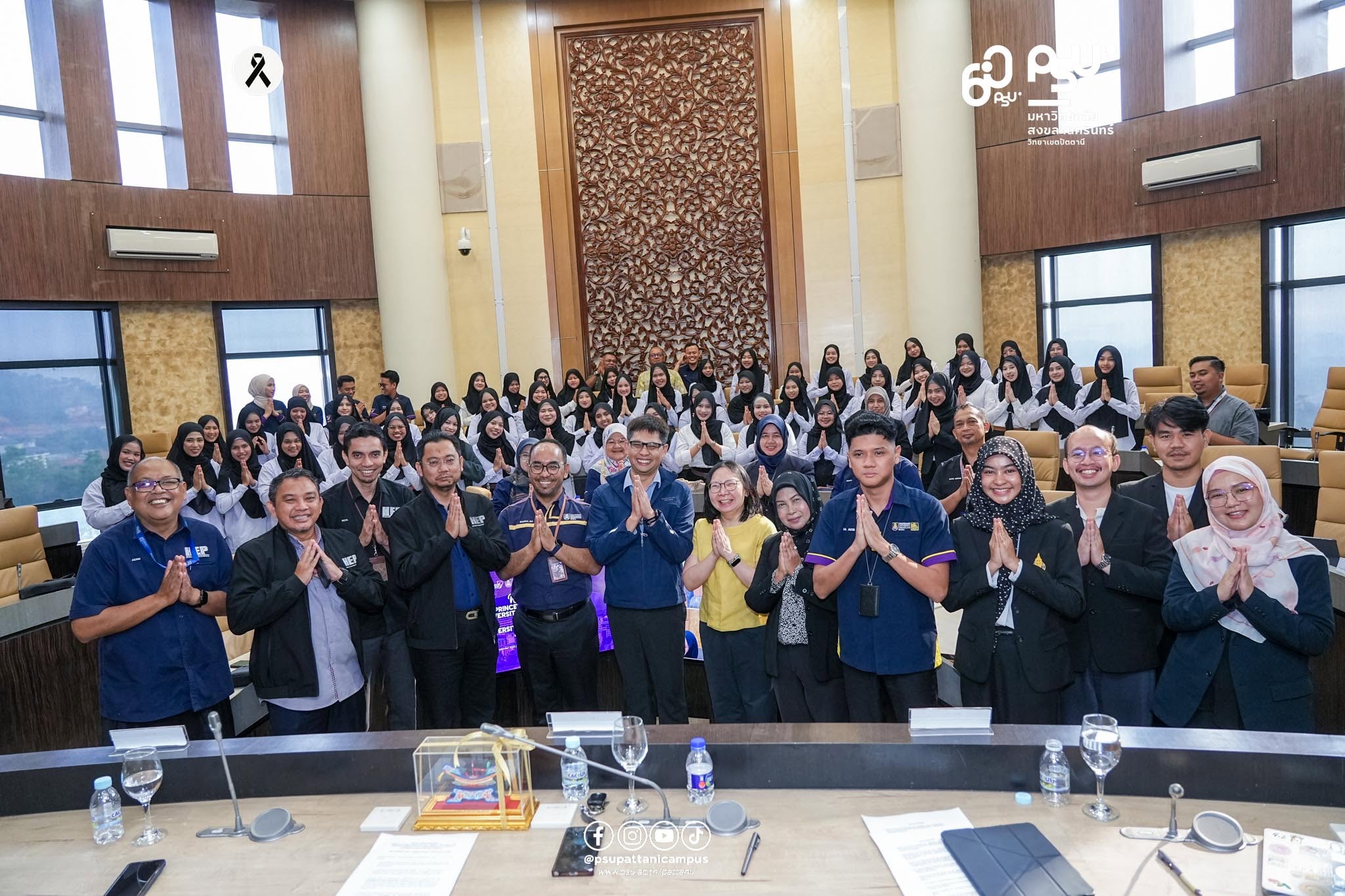
The visit was organized under the “STEM ConnectHER @ PSU Pattani – Cross-Border STEM Learning Trip” project, providing students with an opportunity to experience the STEM ecosystem of a leading Malaysian university and apply the knowledge gained to further develop students at PSU Pattani and prepare them for the rapidly changing technological landscape of the future.
Strengthening Collaboration Between PSU and UiTM
On this occasion, Assoc. Prof. Dr. Badrul Isa, Assistant Vice Chancellor (Entrepreneurship), Malaysian Academy of SME & Entrepreneurship Development (MASMED), Universiti Teknologi MARA (UiTM), welcomed the delegation from Prince of Songkla University, Pattani Campus, at the Dewan Senat.
He expressed his pleasure at welcoming PSU Pattani administrators, staff, and students to UiTM Shah Alam and highlighted the importance of exchanges between the two institutions as an opportunity to strengthen their relationship and expand collaboration in student development, STEM education, leadership, innovation, and cross-border learning.
Assoc. Prof. Dr. Badrul Isa also emphasized the importance of providing students with opportunities to learn from real-world contexts, particularly in technology, innovation, and entrepreneurship. These skills are increasingly important in preparing young people for a rapidly changing workplace, especially in connecting STEM knowledge with creativity, problem-solving, and the creation of economic and social value.
Experiencing the STEM Ecosystem
For the STEM ConnectHER @ PSU Pattani – Cross-Border STEM Learning Trip, the visit to UiTM was more than a study visit. It provided students with a learning environment where they could explore academic support systems, laboratories, research, advanced technologies, entrepreneurship, and innovation.
The experience helped students clearly understand the pathway from “knowledge” to “innovation and real-world application.”
The study visit allowed students to experience STEM beyond textbooks by exploring a real-world STEM ecosystem, ranging from learning resources and laboratories to research, industrial technologies, and knowledge-development spaces.
Students visited and exchanged knowledge at several science and technology facilities at UiTM, particularly the UiTM-TUT Collaboration Lab, which demonstrates an approach to research and innovation collaboration between academic institutions. The laboratory focuses on connecting university knowledge with technology development and innovation.
Such facilities allowed students to gain insight into the research process, from identifying research questions and conducting experiments to developing prototypes and applying research outcomes in real-world contexts. This is at the heart of effective STEM learning: understanding not only how technology works, but also how knowledge can be applied to solve problems and create value.
UiTM also demonstrates a strong focus on research in intelligent systems and automation, including areas such as robotics, intelligent control, and robotic navigation. These areas illustrate the integration of engineering, control systems, software, and artificial intelligence.
Exploring Semiconductor Technology
One of the key highlights was the visit to Makmal Sistem Terbenam dan Automasi Proses Semikonduktor, or the Embedded Systems and Semiconductor Process Automation Laboratory, under the Faculty of Electrical Engineering at UiTM.
The visit provided students with exposure to knowledge underlying modern technologies, including embedded systems, control systems, automation, electronics, and semiconductor-related processes. These technologies form the foundation of smart devices, automation systems, robotics, and the digital industry.
This experience was particularly relevant to students today because semiconductors are fundamental technologies behind a wide range of devices and systems, including smartphones, computers, electric vehicles, IoT devices, AI systems, and industrial automation.
UiTM has also advanced Semikonduktor@UiTM to develop a highly skilled workforce and support Malaysia’s national semiconductor strategy. The initiative includes training infrastructure and laboratories covering areas such as Integrated Circuit Design, Semiconductor Fabrication, Device Testing, and Embedded Systems and Process Automation, while connecting with industry and relevant organizations.
Experiencing these technologies in a real-world setting gave students a valuable opportunity to understand how knowledge from science, mathematics, engineering, and computer science can be integrated into technologies used in industry.
Learning About Polymer Science and Applications
The delegation also visited Makmal Polimer (Polymer Laboratory), another facility demonstrating the application of science to the development of materials and products for real-world use.
Polymer science involves the study of material properties, material design and development, processing, testing, and industrial applications. UiTM offers undergraduate education in Engineering Polymer Technology, covering both theoretical and practical knowledge in areas including plastics, rubber, latex, and composite materials, as well as material processing and testing.
UiTM''''s expertise in polymers is also connected to research and industrial applications, demonstrating how university-based science can contribute to the development of new materials, technologies, and solutions to environmental and industrial challenges.
Learning directly in the laboratory allowed students to visualize the complete process from “raw materials → processing → testing → application.” This represents a practical STEM approach that students can further apply to their own projects and innovation initiatives.
Learning Through Academic Resources
The students also visited Perpustakaan Tun Abdul Razak Sains & Teknologi (PTAR Sains & Teknologi), UiTM Shah Alam''''s specialized science and technology library.
The library serves as an academic resource center for students and staff, supporting teaching, learning, and research. It currently provides 514 seats and houses more than 45,000 resources.
PTAR Sains & Teknologi demonstrates that a modern university library is more than a place to store books. It is an important learning and research infrastructure that connects students with scientific and technological knowledge, databases, and digital resources, supporting lifelong learning and research in the digital era.
From Knowledge to Innovation
The study visit covered a broad range of learning environments, from academic resources at PTAR Sains & Teknologi, to research and innovation facilities such as the UiTM-TUT Collaboration Lab, and specialized laboratories focusing on embedded systems, automation, semiconductors, and polymers.
What PSU Pattani students gained was not simply knowledge of tools and technologies, but an understanding of the pathway from learning → experimentation → research → innovation → real-world application.
The cross-border learning experience also provided students with opportunities to develop language skills, intercultural communication, teamwork with people from different institutions, and an international perspective on education—all essential skills for working in today''''s global environment.
The STEM ConnectHER @ PSU Pattani – Cross-Border STEM Learning Trip therefore goes beyond a conventional study visit. It aims to create a meaningful Cross-Border Learning Experience, allowing students to step outside the classroom and experience education, research, and innovation in an international setting.
Through learning at UiTM, students were exposed to a wide range of fields, from applied science and polymer technology to electrical engineering, automation, embedded systems, and semiconductor technology. The experience demonstrated how different disciplines are interconnected and highlighted that the technologies of the future are not created by a single field, but through collaboration across multiple disciplines.
This cross-border learning experience represents another important step for PSU Pattani in developing students with academic knowledge, STEM skills, creativity, communication abilities, leadership, and an international perspective, empowering them to apply their experiences to further their learning and contribute to the university and society.


